
By Kate Warton (Hand Therapist OT)
What you need to know about the most commonly injured joint in the hand.
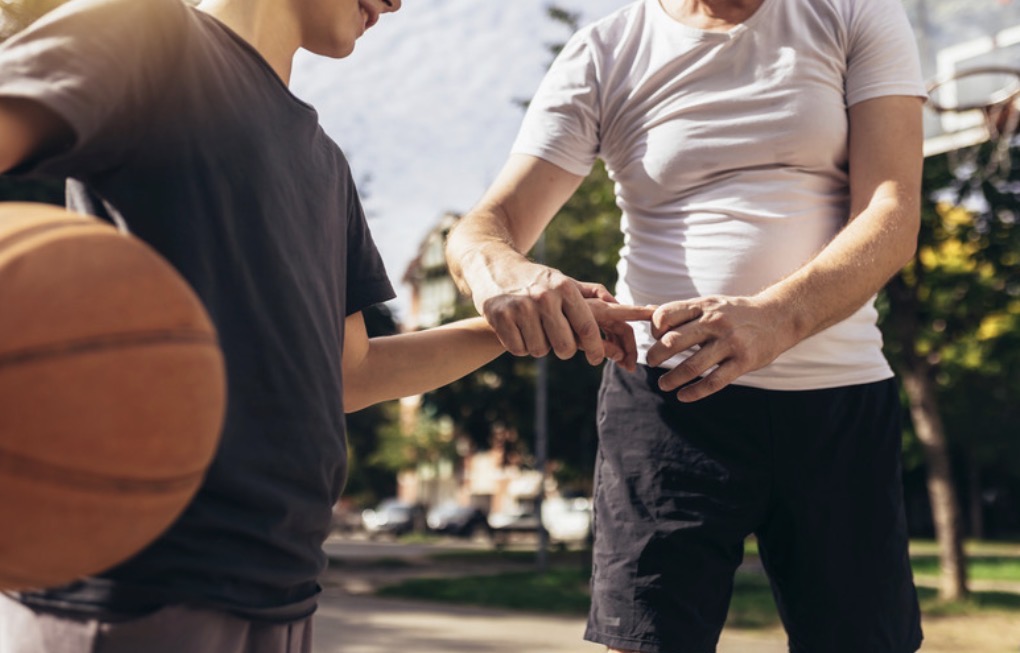
It can happen in a split second. You go to catch a ball awkwardly or trip and try to break your fall. Your finger bends backward or jars, and before you know it, your middle joint starts to swell and feel sore.
This middle joint is known as the PIP joint (which stands for proximal interphalangeal joint). It is crucial to your ability to bend, grip and grasp.
PIP joint injuries are incredibly common and are often brushed off as “just a simple sprain.” However, ignoring a finger injury can lead to long-term stiffness, deformity, or in serious cases, a permanent loss of function.
Here is what you need to know about how these injuries happen and how Hand Therapy helps in getting your hand fully back in the game.
A jarred or hyperextended finger is one of the most common sports injuries.
The PIP Joint
The PIP joint is a complex hinge joint, surrounded by supportive soft tissues. Depending on the direction and force of the impact, a few different structures can be damaged:
Anatomy of the PIP joint structures including the phalanges (finger bones), the volar plate and collateral ligaments.
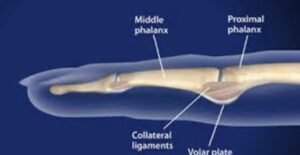
• The Volar Plate: This is a thick, fibrous ligament on the palm side of the PIP joint that stops the finger from hyperextending (bending too far backwards). When the finger is hyperextended, the volar plate can stretch, tear or pull off a small piece of bone (also known as an avulsion fracture).
• Collateral Ligaments: Located on the sides of the joint, these ligaments keep your finger from moving sideways. A hard knock from the side can strain or tear them.
• The Central Slip: This is the tendon on the back of your finger that allows you to straighten the PIP joint. This can also stretch, tear or pull off a small piece of bone (avulsion fracture).
Why We Advise Against the “Wait and See” Approach
The biggest mistake people often make is assuming the finger will heal on its own. The PIP joint is notoriously unforgiving. Injuries here produce significant swelling and the soft tissue and bony structures are easily damaged. The finger can rapidly become very stiff, leaving you unable to make a tight fist or straighten your finger completely.
How Hand Therapy Can Help
A Hand Therapist (an Occupational Therapist or Physiotherapist who specialises exclusively in treating hand and upper limb injuries) will assess your finger for stability, protect the healing tissue and prevent permanent stiffness.
Treatment may include:
• Custom thermoplastic splinting to protect the affected joint
• Compression bandages to manage swelling
• Safe range of motion exercises to prevent permanent stiffness
• Strengthening exercises, once safe to do so
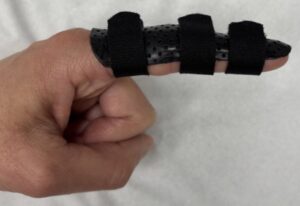
Example of a custom thermoplastic finger splint.
Don’t Let a Sore Finger Linger
If you have a painful finger, do not wait for it to clear up on its own.
References:
1. Merivale Hand Clinic. (2022). PIP joint injury [Brochure]. https://www.merivalehandclinic.co.nz/wp-content/uploads/2022/12/PIPJ-Injury-PRINT.pdf
2. Tan, R. E. S., & Cheah, A. E. J. (2019). Injuries around the proximal interphalangeal joint. Clinics in Plastic Surgery, 46(3), 437–449.
https://doi.org/10.1016/j.cps.2019.03.005
3. Skirven, T., Osterman, A., Fedorczyk, J., Amadio, P., Feldscher, S., & Eoan Kyu Shin. (2021). Rehabilitation of the Hand and Upper Extremity (7th ed.,
Vol. 2). Philadelphia, PA: Elsevier Mosby.